
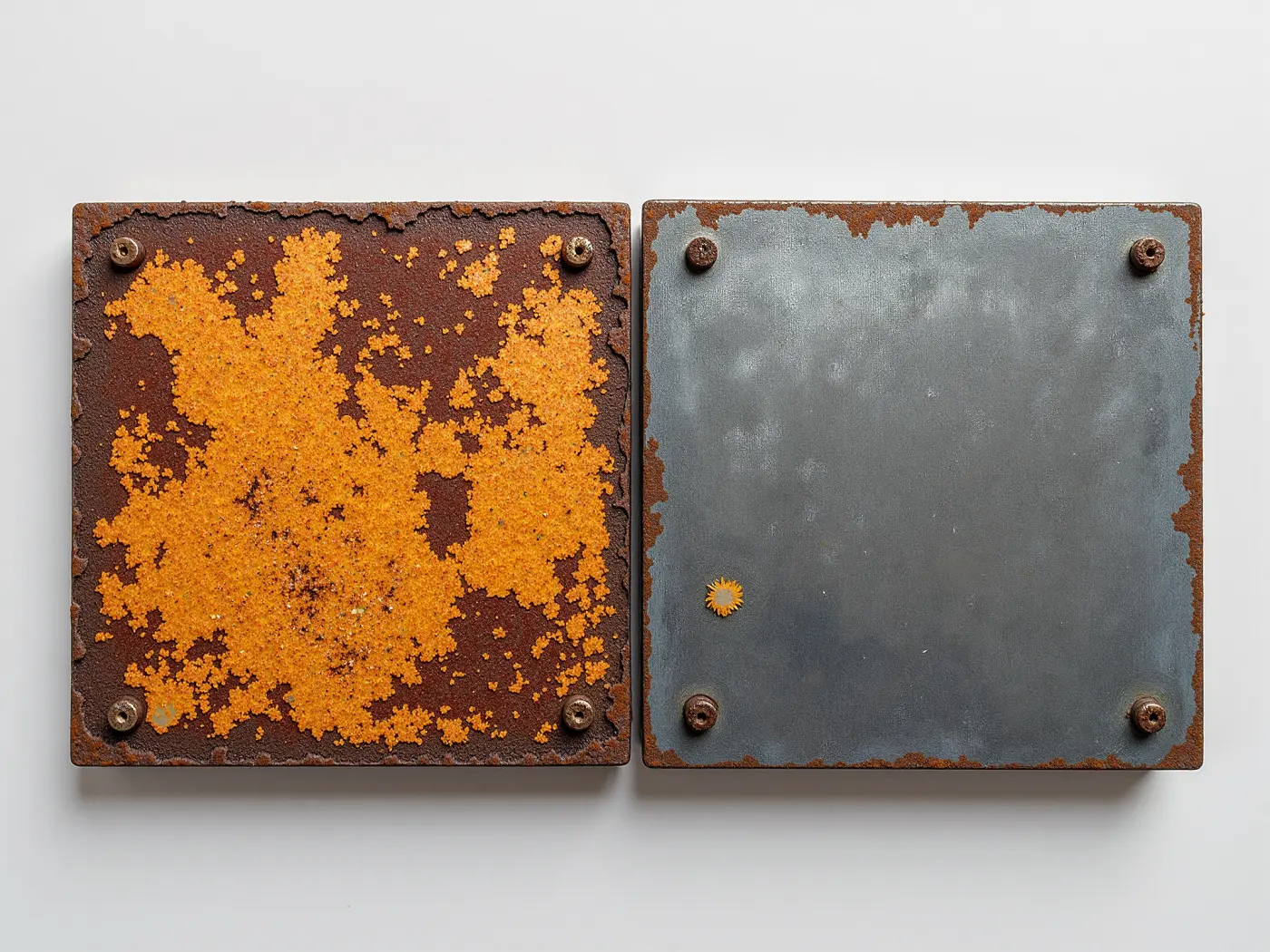
Steel choice locks in a mould's polish ceiling, its maintenance interval and the cycle time you can quote a customer. Two tools with identical geometry can differ by 30% in downtime purely because one block was specified at 30 HRC and the other at 40 HRC. The table below is the shortlist we quote from for injection tooling between 1 and 16 cavities; everything after it explains where each grade stops paying for itself.
| Grade | Hardness (HRC) | Typical application | Volume reference | Relative cost |
|---|---|---|---|---|
| P20 (1.2311) | 28–32 | General injection moulds, large housings, low cosmetic demand | up to ~300,000 shots | 1.0× |
| 718H (1.2738) | 30–34 | Large and thick-section moulds, textured and polished surfaces | 300,000–1,000,000 shots | 1.15–1.3× |
| NAK80 (P21) | 38–42 | Mirror-polish optics, transparent parts, high-gloss cosmetics | 500,000–1,000,000 shots | 1.6–2.0× |
| S136 (1.2083 ESR) | 48–54 (quenched) | PVC, flame-retardant and medical resins, clean-room parts | 1,000,000+ shots | 2.0–2.5× |
| H13 (1.2344) | 45–52 (quenched) | Die-casting dies, hot-runner components, high-heat inserts | 80,000–150,000 casting shots | 1.8–2.2× |
Hardness above is measured on the block as supplied for the pre-hardened grades (P20, 718H, NAK80) and after vacuum quenching and tempering for S136 and H13. Quoted values below assume a 1.2311 or 1.2738 base block, not a re-melted variant; ESR stock will read 1–2 HRC higher and polish noticeably better.
P20: the default for general tooling
P20 (DIN 1.2311) arrives pre-hardened at 28–32 HRC, which means a mould can be cut, spotted and sampled without a heat-treatment step — typically 5–8 working days saved on a medium tool. It machines cleanly, accepts standard EDM and takes a good satin or matt texture. Its limits appear at two points: deep ribs below 2 mm wall thickness, where the softer matrix wears at the edge, and high-gloss ABS or PC parts, where polishability caps out around a SPI B-2 finish. For a 2-cavity enclosure with a 300,000-shot forecast, P20 is usually the cheapest route that still holds tolerance across years of production.
When 718H earns its premium
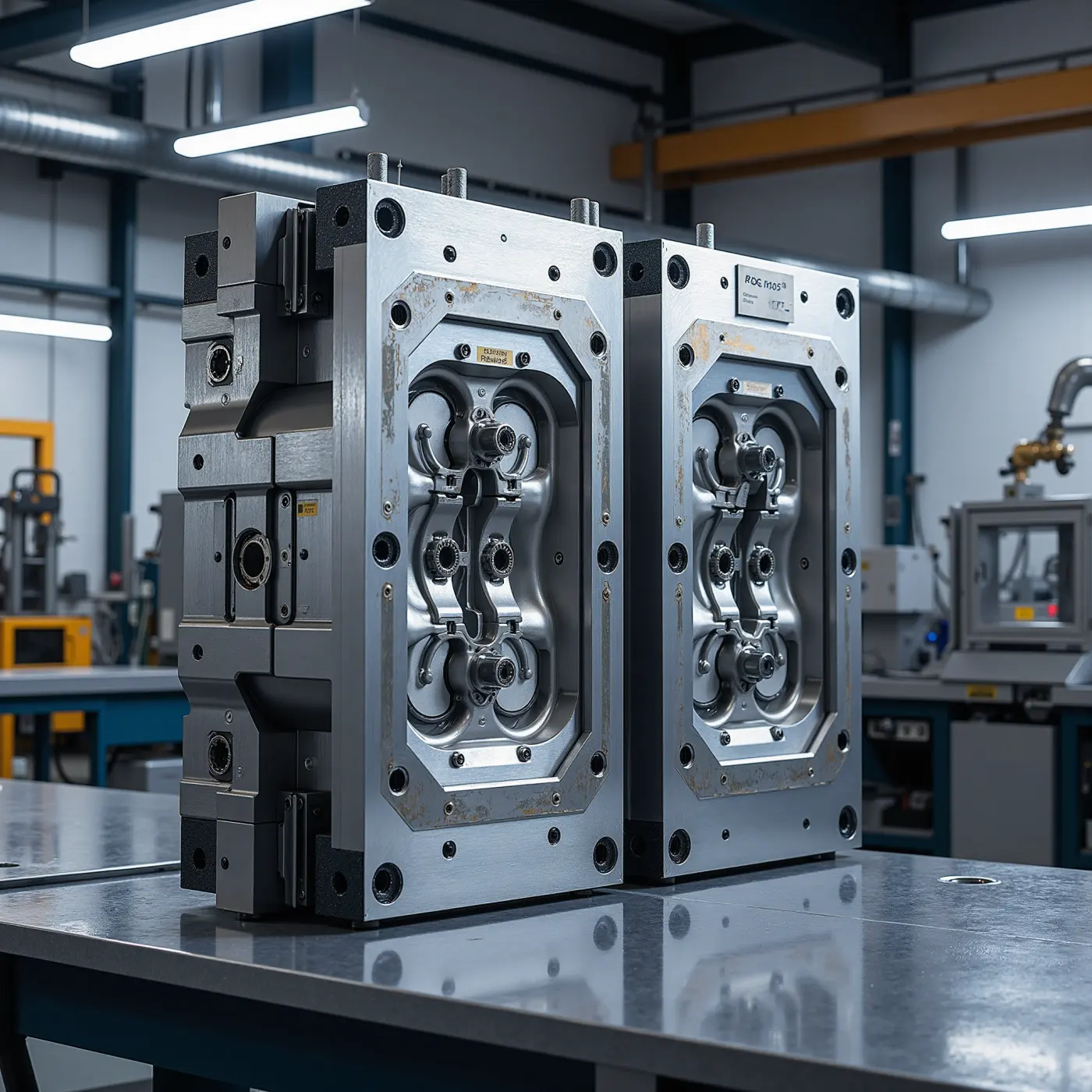
718H (1.2738) is P20 chemistry with roughly 1% nickel added and delivered at 30–34 HRC. The extra hardness buys three things: better through-section consistency in blocks over 400 mm thick, a noticeably finer polish, and improved texture reproduction on grained surfaces. We move to 718H when a tool is expected to run 300,000 to 1,000,000 shots, or when the part carries a visible grained finish that a P20 block would show as orange-peel after the second re-polish. The cost delta is 15–30% on material, which on a 6-cavity tool is normally recovered within the first two maintenance cycles.
NAK80: mirror polish and optics
NAK80 is a precipitation-hardened 10Ni3MnCuAl grade supplied at 38–42 HRC. It polishes to a true mirror — SPI A-1 — and holds that finish through repeated cleaning, which is why it dominates transparent lenses, light guides and high-gloss cosmetic covers. The trade-offs are real: it welds poorly, so a late engineering change usually means cutting a fresh insert rather than repairing one, and it is harder on small-diameter cutters, adding roughly 10% to milling time. Specify NAK80 only where the part genuinely needs the optical surface; on a hidden bracket it is money burnt.

S136: corrosion and aggressive resins
S136 (1.2083, ESR remelted) is a 13% chromium stainless supplied annealed and hardened to 48–54 HRC after machining. It enters the quotation for one reason: aggressive resin chemistry. PVC releases hydrochloric acid, and flame-retardant ABS or PC grades release corrosive by-products; both will pit a P20 cavity within a few hundred thousand shots, forcing polish-outs that eventually move the part geometry. Medical and food-contact parts add a cleaning regime that is unfriendly to carbon steel. S136 roughly doubles material cost and requires vacuum hardening plus a second temper, so allow 7–10 extra days — but it is the difference between a five-year tool and a two-year one in a PVC application.
H13 and the hot-work boundary
H13 (1.2344) is the hot-work grade and belongs on the die-casting side rather than in injection. At 45–52 HRC it resists thermal fatigue and washout from molten aluminium at 650–700°C, and survives 80,000–150,000 casting shots before the heat-checking network needs dressing. In injection moulds it appears mainly as a targeted insert behind a hot gate, or in high-heat engineering-resin work where a P20 insert would soften and sink.
Matching steel to volume and resin
Cavity count scales the decision faster than part size. A single-cavity prototype tool can run P20 with no regret, because the tool will be retired long before wear matters. At 8 or 16 cavities the same steel wears 8 to 16 times faster per production hour, and a maintenance window that was acceptable at 300,000 shots becomes a weekly stoppage. Resin is the second filter: unfilled PP and PE are gentle, while 30% glass-filled nylon will erode even a hardened gate, pushing you toward H13 or a hardened S136 gate block whatever the base material.
Decision checklist
- Forecast under 300,000 shots with no cosmetic requirement: P20, 28–32 HRC.
- 300,000–1,000,000 shots, grained or high-polish surface, thick blocks: 718H, 30–34 HRC.
- Transparent, light-guide or SPI A-1 gloss parts: NAK80, 38–42 HRC, and accept the weld and EDM penalty.
- PVC, flame-retardant resins, medical or food contact: S136 ESR, 48–54 HRC.
- Die casting or sustained melt temperatures above 250°C: H13, 45–52 HRC.
- Any tool running glass-filled resin at the gate: budget for a hardened insert even if the base block stays P20.
- Ask for the hardness reading on the actual machined block, not the mill certificate alone.